What happened on 31 August 2026 and why it affects your plot
On 31 August 2026, in municipalities (gmina) that had not finished their general plan (plan ogólny), the studies of conditions and directions of spatial development (studium uwarunkowań i kierunków zagospodarowania przestrzennego) expired. From 1 September 2026, a zoning conditions decision (WZ / decyzja o warunkach zabudowy) on a new application can be issued only where the municipality’s general plan has entered into force. This follows from Article 59(3) of the Act of 7 July 2023 amending the Act on Spatial Planning and Development (Journal of Laws 2023, item 1688), as amended in 2025 and 2026.
The deadline was postponed twice. Originally the studies were due to expire on 31 December 2025. The Act of 4 April 2025 (Journal of Laws 2025, item 527) moved the date to 30 June 2026, and the Act of 30 April 2026 (Journal of Laws 2026, item 781) moved it to 31 August 2026. There was no third extension.
How many municipalities made it? According to data from the Ministry of Development and Technology, presented on 1 September 2026 by Deputy Minister Tomasz Lewandowski, by 31 August 2026 a general plan had been adopted and published by 877 municipalities, or 35.37% of Poland’s 2,479 municipalities (the number of municipalities according to Statistics Poland, as of 1 January 2026). That means roughly 1,600 municipalities entered September without a general plan. The figures differ slightly depending on the source and the counting method (a list handed on 7 September 2026 to auditors verifying the EU recovery plan milestone named 819 municipalities), but the order of magnitude is the same: about one in three municipalities has a plan.
An important detail: what counts is the plan entering into force, not merely the adoption of the resolution. A general plan is an act of local law (Article 13a(7) of the Act on Spatial Planning and Development) and takes effect after publication in the voivodeship official gazette, on the date set in the resolution. A municipality that adopted its plan at the end of August may therefore spend several more weeks in a “gap” in which it issues no new WZ decisions.
Three situations: a plot with a local plan, a municipality with a general plan, a municipality without one
What changed on 1 September depends on which planning documents apply to your plot. There are three possible situations.
1. The plot is covered by a local zoning plan (MPZP): nothing changes
Existing local zoning plans (MPZP / miejscowy plan zagospodarowania przestrzennego) remain in force (Article 67(1) of the Act of 7 July 2023). You obtain the building permit on the basis of the MPZP, and no WZ decision is needed. On 1 September the Ministry stressed that existing local plans and issued WZ decisions remain valid, so the vast majority of projects already under way proceed undisturbed.
2. A municipality with a general plan: WZ is possible, but on new terms
If the general plan has entered into force, the office issues WZ decisions, but there is a new condition: the site must lie within an infill development area (obszar uzupełnienia zabudowy, OUZ; Article 61(1)(1a) of the Act on Spatial Planning and Development), and the decision must comply with the planning zone and the municipal urban standards set in the general plan (Article 13a(5)). The existing conditions of Article 61(1) still apply: a developed neighbouring plot accessible from the same public road (the so-called “good neighbourhood” rule), access to a public road, adequate utilities, and no need to obtain consent to remove the land from agricultural use.
3. A municipality without a general plan: new WZ and new MPZP are blocked
In a municipality where the general plan has not entered into force, a WZ application filed on or after 1 September 2026 cannot result in a decision until the general plan takes effect (Article 59(3) of the Act of 7 July 2023). The only exception is closed areas. The municipality also cannot adopt a new local plan or amend an existing one (Article 67(4) of that Act), unless it had already announced the public display of the draft before the study expired, or the plan concerns only public-purpose investments or strategic natural resources. This also covers integrated investment plans (ZPI), which are a special form of local plan.
| Situation | New WZ application (from 1 Sept 2026) | WZ application filed by 31 Aug 2026 | New MPZP or amendment |
|---|---|---|---|
| Plot with an MPZP in force | not needed: you build on the basis of the plan | n/a | only after the general plan enters into force (with exceptions) |
| Municipality with a general plan in force | yes, if the plot lies within an infill development area | yes, under the previous rules | yes |
| Municipality without a general plan | no, until the general plan enters into force | yes, under the previous rules | no (with the exceptions in Article 67(4)) |
Filed before 1 September? Your case continues under the old rules
What matters is the date the application was filed, not the date the decision is issued. For cases initiated after 24 September 2023 but before the study expired in the given municipality, transitional provisions apply (Article 59(2) of the Act of 7 July 2023): the plot does not have to lie within an infill development area, and the neighbourhood analysis is carried out under the previous Article 61(5a), with an analysed area whose radius is at least three times the width of the plot frontage and not less than 50 m, but without the new 200 m cap. The office therefore cannot refuse a WZ decision merely because the municipality has no general plan, provided the application was received by 31 August 2026.
Still, keep a close eye on the case: fix formal deficiencies on time and do not withdraw the application, because filing again after 1 September is subject to the new rules. Expect a longer wait too: the Act of 5 November 2025 (Journal of Laws 2025, item 1668) suspended until 31 December 2026 the time limits whose breach would expose the municipality to a penalty for delay in issuing a WZ decision, so the actual processing time may be longer than usual.
How long will such a decision remain valid? WZ decisions that became final from 1 January 2026 expire after 5 years (Article 64c of the Act on Spatial Planning and Development). Decisions that became final before 1 January 2026, and those issued in cases initiated before 16 October 2025, remain valid indefinitely (Article 62 of the Act of 7 July 2023, as amended by the Act of 5 November 2025). So if you filed, say, in July 2026, you will receive a decision valid for 5 years from the date it becomes final, which is enough time for the design and the building permit. You will find more on the procedure in our guide to zoning conditions decisions.
The infill development area (OUZ): the condition that now decides on WZ
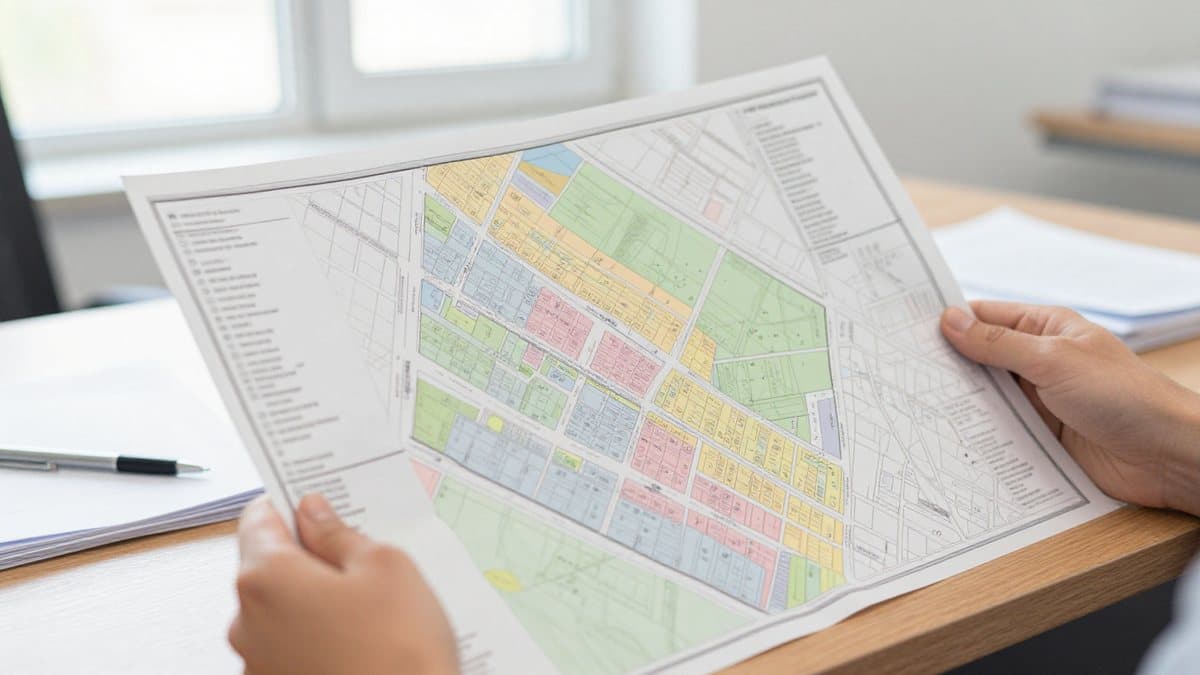
The infill development area is an element of the general plan that a municipality may, but does not have to, designate (Article 13a(4)(2) of the Act on Spatial Planning and Development). If the general plan does not designate an OUZ, you cannot obtain a WZ decision for a new building in that municipality, apart from the exceptions described below. That is why the OUZ is now the most important line on the map for anyone who owns a plot without a local plan.
The method for designating the OUZ is set out in the Regulation of the Minister of Development and Technology of 2 May 2024 (Journal of Laws 2024, item 729). The starting point is clusters of at least 5 buildings in which every building stands no more than 100 m from another building in the cluster. A 50 m buffer is drawn around them, closed gaps of up to 5,000 m² are added, and the boundary is then pulled back 40 m inwards. The municipality may reduce the resulting area and, to a limited extent, also extend it, guided by local conditions and its spatial policy (§ 1(4) and (5) of the regulation). In practice, the OUZ covers existing villages and housing estates together with the gaps between buildings, and usually does not cover fields and meadows distant from development, even if a WZ decision on the “good neighbourhood” principle could have been obtained there until now.
When an OUZ is not required (Article 61(1a)): for projects that change land development other than by constructing a building, for the reconstruction, extension or raising of an existing structure, and on closed areas. In addition, the good neighbourhood and OUZ requirements do not apply to, among other things, roads and railway lines, linear structures and technical infrastructure, renewable energy installations, water facilities, petrol stations and publicly accessible charging stations, farm outbuildings of up to 35 m² for agricultural purposes, afforestation and forestry structures (Article 61(3)).
Beyond the OUZ there is also the functional profile of the planning zone: you will get a WZ decision for a single-family house only in a zone whose profile permits single-family housing, and the parameters (maximum above-ground building intensity, maximum height, maximum building coverage and minimum share of biologically active area, i.e. powierzchnia biologicznie czynna) must fit within the municipal urban standards (Article 13e). We explain how to calculate these ratios in the article Building intensity in Poland: how to calculate it.
How to check whether your municipality has a general plan: 3 sources
- The Urban Planning Register (Rejestr Urbanistyczny) (in Polish): rejestr-urbanistyczny.gov.pl. Launched on 1 July 2026 by the Ministry of Development and Technology, it is free and collects general plans, local plans and other spatial planning acts. Note that during the transition period the data may be incomplete: local governments have until 30 November 2026 to make their data sets available.
- The national Geoportal (in Polish): geoportal.gov.pl, the “Plany ogólne gmin” (municipal general plans) service run by GUGiK on the basis of resolutions published by municipalities. After zooming in you will see planning zones, infill development areas and city-centre development areas, so you can check whether a specific plot lies within an OUZ.
- The municipality’s BIP (Public Information Bulletin) and the voivodeship official gazette: this is where you will find the resolution, the date of its publication and the date it enters into force. It is the most reliable source when the plan was adopted recently and has not yet reached the registers. The simplest approach is to call the municipality’s spatial planning department and ask three things: whether the general plan is in force, which zone the plot lies in, and whether it is in an OUZ.
And where can you check whether a plot has a local plan? In the Zabudowa.com.pl app (interface in Polish), enter the plot number or address. In 2 minutes you will see whether the plot is covered by an MPZP and what its parameters are: designation, height, intensity and building coverage. If there is no local plan, you know that your options are decided by the general plan and the OUZ, which you check in the sources above.
What to do now: 5 scenarios
You have a final WZ decision
The decision remains valid. Just check until when: indefinitely if it became final before 1 January 2026 or was issued in a case initiated before 16 October 2025; otherwise 5 years from the date it became final. A general plan does not in itself cause a WZ decision to expire. Only the adoption of a local plan with different provisions can have that effect (Article 65(1)(2) of the Act on Spatial Planning and Development), unless you already hold a final building permit.
You filed a WZ application before 1 September
The case proceeds under the previous rules. Keep an eye on the deadlines for supplementing missing documents, respond to the office’s requests and do not withdraw the application.
You own a plot with no MPZP and no WZ in a municipality without a general plan
Until the general plan enters into force, you will not obtain a new WZ decision. Follow the work on the draft plan in the municipality’s BIP and take part in the public consultation, which is the moment to submit comments so that the plot is placed in a zone with a residential profile and within the infill development area. Also check the land classification and the neighbourhood: a plot far from a cluster of buildings has little chance of being included in an OUZ, as we describe in our article on building on agricultural, forest and farmstead land.
You are buying a plot without a local plan
Do not rely on the argument “the neighbour got a WZ decision”: after 1 September, what counts is the general plan, the zone and the OUZ. Check them before signing the agreement and write a WZ-approval condition into the preliminary contract. An important change is on the horizon: from 1 January 2027, a WZ decision is issued only to an applicant who has the right to dispose of the property for construction purposes (Article 63(1a), added by the Act of 30 April 2026). Until the end of 2026 anyone can file an application. These are the last months in which you can test someone else’s plot “for WZ” before buying it, of course in a municipality with a general plan in force. You will find the full checklist in our article What to check before buying land in Poland.
You are planning a larger investment
In a municipality without a general plan you cannot get an MPZP or a ZPI adopted, and without an OUZ you will not get a WZ decision. The realistic path is plots covered by an MPZP in force. You can find and analyse those in a few minutes in the app, together with building variants and real transaction prices from the area.
| Date | What changes |
|---|---|
| 1 January 2026 | new WZ decisions are valid for 5 years from becoming final (Art. 64c) |
| 1 July 2026 | launch of the Urban Planning Register |
| 31 August 2026 | studies expire in municipalities without a general plan |
| 1 September 2026 | new WZ applications only in municipalities with a general plan in force; new MPZPs only with a general plan |
| 30 November 2026 | deadline for municipalities to make their data sets available in the Urban Planning Register |
| 31 December 2026 | end of the suspension of time limits that would expose municipalities to a penalty for delay in issuing WZ |
| 1 January 2027 | WZ application only with a right to dispose of the property for construction purposes |
Summary: 7 things to remember
- The deadline for general plans passed on 31 August 2026; 877 municipalities (35.37%) made it, and about 1,600 are without a plan.
- From 1 September, a new WZ application can be processed only in a municipality where the general plan has entered into force, and only for a plot within an infill development area.
- Applications filed by 31 August proceed under the old rules, without the OUZ requirement.
- Issued WZ decisions and local plans in force remain valid; new WZ decisions expire after 5 years.
- A municipality without a general plan also cannot adopt a new local plan (with exceptions).
- You can check a municipality’s status in the Urban Planning Register, on geoportal.gov.pl and in the municipality’s BIP, and a plot’s MPZP in the Zabudowa.com.pl app.
- From 1 January 2027, only a person with the right to dispose of the property can apply for a WZ decision.
Own a plot and not sure which of the three situations you are in? Start with a free plot analysis (interface in Polish). You will check the MPZP, building parameters, flood risk zones and real prices from the area, and then verify the general plan in the sources listed in this article.
Sources and legal basis
All legal sources below are Polish-language official publications.
- Act of 27 March 2003 on Spatial Planning and Development (consolidated text, Journal of Laws 2026, item 538) (in Polish): Articles 13a, 13e, 61, 63, 64c, 65.
- Act of 7 July 2023 amending the Act on Spatial Planning and Development and certain other acts (Journal of Laws 2023, item 1688) (in Polish): Articles 59, 62, 65, 67 (transitional provisions).
- Amendments to the transitional provisions: Act of 4 April 2025 (Journal of Laws 2025, item 527), Act of 26 September 2025 (Journal of Laws 2025, item 1543), Act of 5 November 2025 (Journal of Laws 2025, item 1668), Act of 30 April 2026 (Journal of Laws 2026, item 781).
- Regulation of the Minister of Development and Technology of 2 May 2024 on the method of designating the infill development area in a municipal general plan (Journal of Laws 2024, item 729).
- Data on the number of municipalities with a general plan: Ministry of Development and Technology, as of 31 August 2026 (as reported by propertynews.pl, 1 September 2026) and the list of 7 September 2026 (as reported by portalsamorzadowy.pl, 16 September 2026), both in Polish. Number of municipalities: Statistics Poland, “Poland in Figures 2026”.
- Urban Planning Register launched: Ministry announcement (in Polish, 1 July 2026).
This article is for information purposes only and is not legal advice. For a specific plot, consult a Polish attorney (radca prawny or adwokat) or a licensed planner. The legal position is as at 22 September 2026.
Check your plot
Enter the plot number and find out in 2 minutes what you can build on it. Free, no sign-up. (The analysis tool is in Polish and covers Polish plots.)
Analyze a plot for freeRelated articles
Poland’s 2026 Planning Reform — 3 Dates That Change the Property Market
Poland’s 2026 planning reform: zoning decisions valid for 5 years, mandatory municipal general plans, no more open-ended approvals. The 3 key dates explained.
Zoning Conditions in Poland (WZ) 2026: The Complete Guide
What a zoning conditions decision (WZ) is in Poland, how to apply, what it costs and how long it takes. Parameters, urban analysis and the 2026 reform.
Buying Land in Poland: 12 Checks That Can Save You Thousands
A 12-point checklist for buying building land in Poland: local zoning plan, zoning conditions, utilities, road access, soil, flood risk and land register.