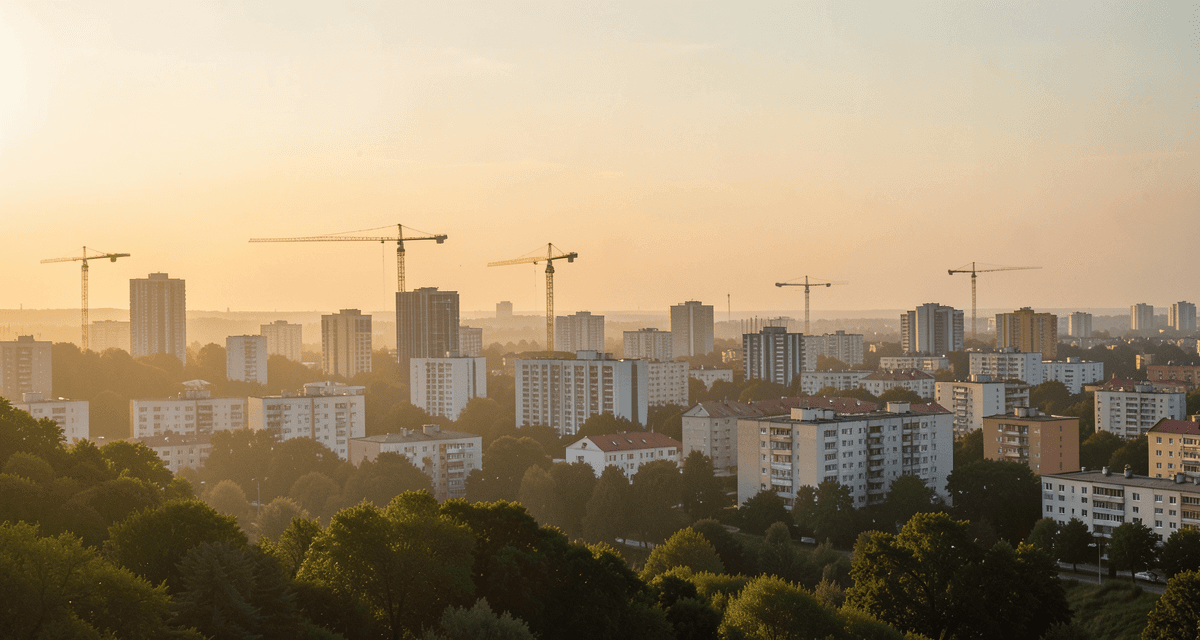
Why this reform changes everything
For more than two decades, Poland’s spatial planning system rested on two pillars: the study of conditions and directions of spatial development (studium, a strategic document that was not directly binding) and zoning conditions decisions (WZ / decyzja o warunkach zabudowy), which filled the gap wherever no local zoning plan existed. In practice, more than 60% of building projects in Poland were built on the basis of WZ decisions — often with no connection to any coherent spatial vision for the municipality.
The consequences were plain to see: chaotic development on the edges of cities, housing estates without infrastructure, and conflicts between residential and industrial uses. WZ decisions were issued for an unlimited period, which let owners hold them for years as an “insurance policy” on a plot with no real intention to build.
The Act of 7 July 2023 amending the Spatial Planning and Development Act (Journal of Laws 2023, item 1688), supplemented by the amendment of 5 November 2025 (Journal of Laws 2025, item 1668), fundamentally changes this system. Three dates mark the milestones of the reform — and each has a direct impact on land values, the ability to build and investment strategies.
1 January 2026 — zoning conditions valid for only 5 years
From 1 January 2026, every new zoning conditions decision (WZ) is issued for a fixed term — exactly 5 years from the day it becomes final. This ends the era of open-ended WZ decisions, which for years hampered municipalities’ freedom to plan their territory.
What about decisions issued earlier? Here the detail matters: WZ decisions that became final before 1 January 2026 remain valid indefinitely. The same applies to decisions issued in proceedings initiated before 16 October 2025 — even if they only became final after New Year.
For investors this is a clear signal: it pays to understand the new rules on zoning conditions before deciding to buy a plot. The five-year limit forces real delivery of the project — you can no longer apply for a WZ and postpone construction to some unspecified future.
Practical consequences:
- Developers must plan schedules more precisely — between obtaining the WZ and the building permit, realistically only 3–4 years remain (allowing for design time).
- Speculative stockpiling of WZ decisions no longer makes economic sense.
- The local zoning plan (MPZP / miejscowy plan zagospodarowania przestrzennego) becomes more important as a more stable legal basis for a project — an MPZP does not expire after 5 years.
31 August 2026 — the municipal general plan becomes mandatory
The original deadline for municipalities to adopt general plans (plan ogólny) was 31 December 2025. The Act of 4 April 2025 moved it to 30 June 2026, and a further amendment pushed it to 31 August 2026. The reason? At the end of 2025, around 25% of municipalities had not yet started the procedure for preparing this document.
What is a general plan? It is a new planning document that replaces the former study of conditions and directions of spatial development. Unlike the study, the general plan is an act of local law — it is directly binding when WZ decisions are issued and when local zoning plans are adopted.
The general plan covers the entire municipality and is prepared exclusively in digital form. It defines planning zones (for example, a multifunctional zone with residential development, a green zone, a production zone) and municipal urban planning standards, which set the indicators and development parameters for each zone.
The key element: the general plan designates the so-called infill development area (obszar uzupełnienia zabudowy) — the only area where WZ decisions can be issued once the reform takes effect. Plots outside this area will be buildable only under an MPZP or an integrated investment plan.
The integrated investment plan (ZPI / zintegrowany plan inwestycyjny) is a new tool that replaces the so-called “lex deweloper”. It is adopted by the municipal council at the investor’s request, and before adoption the parties conclude a planning agreement — the investor may commit, for instance, to building public infrastructure in exchange for a favourable land designation.
After 31 August 2026 — WZ only in line with the general plan
Once the deadline for adopting general plans passes, a groundbreaking change follows: zoning conditions may be issued only in areas designated in the general plan as infill development areas. In municipalities that have not adopted a general plan, the issuing of WZ decisions will be blocked entirely.
A limit on the analysed area. The reform sets rigid limits for the urban analysis: the analysed area will be defined at a distance of three times the width of the plot’s frontage, but not less than 50 m and not more than 200 m. This ends the practice of stretching the analysed area across the whole neighbourhood in search of a “development precedent”.
What does this mean in practice?
- A WZ decision must comply both with the general plan (zone, indicators) and with the analysis of the neighbourhood within 200 m — the massing, architectural form, building line and building intensity must match the surroundings.
- Municipalities without a general plan will be unable to issue WZ decisions or adopt new MPZPs — a potential investment paralysis.
- The planning register (rejestr urbanistyczny) — a new web portal run by the minister — will collect data on all WZ applications and issued decisions nationwide, bringing unprecedented transparency to the planning process.
The deadline has passed — what now? The situation after 1 September 2026 — how many municipalities made it, what happens to applications filed before 1 September and how to check the status of your municipality — is described in our article Municipality without a general plan after 1 September 2026.
Which plots will lose their building potential
The planning reform is not neutral for landowners. Some plots on which zoning conditions could theoretically be obtained may, once the general plan is adopted, end up in a zone that excludes residential development.
Risk groups:
- Agricultural and forest land without an MPZP — if the general plan does not include them in the infill development area, obtaining a WZ will not be possible. It is worth understanding the differences between farmstead, agricultural and forest land, because each will be treated differently under the new planning zones.
- Land in protection zones — nature protection, landscape, archaeological or flood zones can effectively rule out development, even if WZ decisions were issued there before.
- “Wedged-in” plots between farmland — small plots surrounded by agricultural land, which until now obtained a WZ on the basis of “good neighbourhood” with a single built-up property within the analysis radius, may lose that option once the area is limited to 200 m.
- Municipalities without a general plan — in municipalities that fail to adopt the document in time, all plots without an MPZP will be temporarily blocked for investment.
Paradoxically, plots covered by a binding MPZP are in the best position — a local zoning plan does not lose validity and remains a stable legal basis for development regardless of whether the municipality has adopted a general plan.
What to do now — 5 protective steps
Whether you are an investor planning a build, a plot owner or a real estate agent, it is worth taking concrete action now:
- 1. Check whether your plot is covered by an MPZP. A local zoning plan is the strongest protection — its provisions apply regardless of the reform. Enter the plot number in Zabudowa.com.pl (interface in Polish) and the system will automatically check whether an MPZP applies and retrieve the development parameters. For the full checklist, read our guide.
- 2. If there is no MPZP — check the municipality’s draft general plan. Many municipalities publish draft general plans for public consultation. Check which planning zone your plot falls into and whether it lies within the infill development area.
- 3. Consider filing a WZ application before 30 June 2026. If the plot has no MPZP and you plan to build in the coming years, an application for zoning conditions filed during the transitional period will be handled under the existing rules (but note — the decision will be valid for only 5 years).
- 4. Verify the surroundings of the plot. The new 200 m limit on the analysed area means the immediate neighbourhood is what counts. Use the Zabudowa.com.pl tool to analyse the surroundings, parameters and zoning conditions.
- 5. Consult an expert. The reform introduces many legal nuances — especially in the transitional provisions. A Polish lawyer specialising in construction law can help assess the risk and plan the best strategy.
It is also worth remembering the new rules on public participation — the reform widens residents’ opportunities to take part in planning procedures. If your municipality’s general plan is at the consultation stage, you have the right to submit comments and requests concerning the designation of specific areas.
Summary and next steps
The planning reform is the most comprehensive change to Poland’s spatial management system since 2003. Three key dates define the new reality:
| Date | Change | Effect |
|---|---|---|
| 1 January 2026 | WZ valid for 5 years | End of open-ended decisions; pressure to deliver projects |
| 31 August 2026 | Deadline for the general plan | Municipalities without a plan lose the ability to issue WZ decisions and adopt new MPZPs |
| After 31 August 2026 | WZ only within the infill development area | WZ decisions only in areas designated in the general plan; analysis area capped at 200 m |
For anyone who owns a plot, plans to buy land or is considering a building project, the reform means one thing: time to act. Check the planning status of your property, review the municipality’s draft general plan and make an informed decision before the new rules take full effect.
Check the zoning conditions of your plot on Zabudowa.com.pl (interface in Polish) — enter the plot number and within minutes see the development parameters, the local zoning plan and the surroundings.
Check your plot
Enter the plot number and find out in 2 minutes what you can build on it. Free, no sign-up. (The analysis tool is in Polish and covers Polish plots.)
Analyze a plot for freeRelated articles
No General Plan, No Zoning Decision? Building in Poland After 1 September 2026
The deadline for municipal general plans passed on 31 Aug 2026 and only 35% of municipalities made it. Can you still get a WZ zoning decision? Rules, next steps.
Zoning Conditions in Poland (WZ) 2026: The Complete Guide
What a zoning conditions decision (WZ) is in Poland, how to apply, what it costs and how long it takes. Parameters, urban analysis and the 2026 reform.
Buying Land in Poland: 12 Checks That Can Save You Thousands
A 12-point checklist for buying building land in Poland: local zoning plan, zoning conditions, utilities, road access, soil, flood risk and land register.